
Home / International / Remote Staffing from Africa
Remote Staffing from Africa for Employers Worldwide
Lynn HR recruits skilled remote professionals in Kenya and across Africa for companies in the USA, Canada, the UK and Europe, Australia and the Middle East. We source, assess and shortlist; you hire.
Remote staffing from Africa is the practice of hiring skilled professionals who live in African countries to work remotely for companies abroad, usually in North America, Europe, Australia or the Middle East. The professionals work from their home country during agreed hours, and the employer engages them directly, as contractors, or through an employer of record. Lynn HR is a recruitment firm based in Nairobi, Kenya, that sources, screens and shortlists remote professionals in Kenya and across Africa for international employers.
Key takeaways
- Africa shares most of the European working day and can cover the US morning on later shifts.
- English is a working language in Kenya, Nigeria, South Africa, Ghana, Uganda and Rwanda.
- Kenya, and Nairobi in particular, is a strong hub for remote customer support, finance, marketing and tech talent.
- Choose an engagement model first: direct hire, contractor or employer of record.
- Plan for compliance: data protection (GDPR, Kenya DPA) and worker classification (IRS, CRA, ATO, IR35).
- Lynn HR recruits for employers: we source, assess and shortlist; you make the hiring decision.
This guide explains how remote staffing from Africa works, where the strongest talent pools are, which roles suit it, the hiring models and legal points to check, and how to choose a partner. It is written for employers in the USA, Canada, the UK and Europe, Australia and the Middle East.
What is remote staffing from Africa?
Remote staffing from Africa sits between traditional offshoring and freelancing. Unlike a business process outsourcing (BPO) contract, you are not buying a service delivered by a vendor's team; you are adding named people to your own team. Unlike a freelance marketplace, you hire for an ongoing role, with set hours, your tools and your management.
In practice, remote staffing from Africa means a professional in Nairobi, Lagos, Accra or Cape Town logs in to your systems each day, joins your stand-ups and reports to your manager. The difference from a local hire is mainly the contract and the location: who employs the person, which country's rules apply, and how pay reaches them.
That is where a recruitment partner helps. Lynn HR finds and assesses the right professionals, and advises on the practical setup, so your first remote hire in Africa starts well.
Why choose remote staffing from Africa?
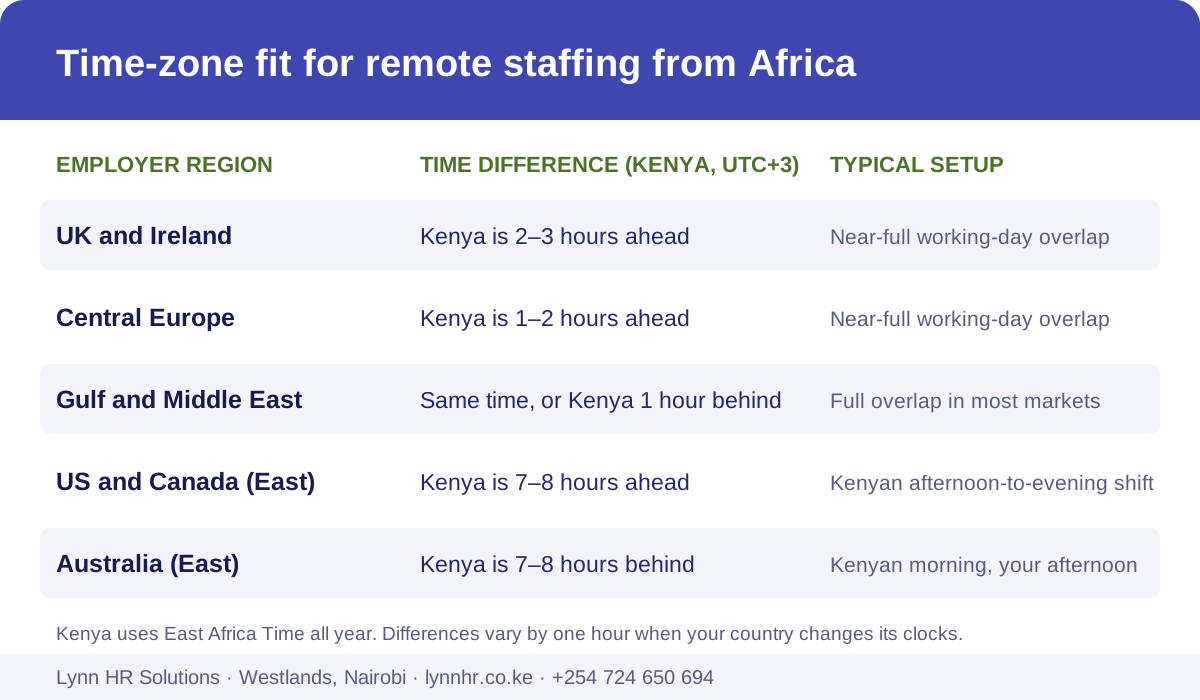
Time zones that match your day. Kenya uses East Africa Time (UTC+3) all year, with no daylight saving. That puts Nairobi one to three hours ahead of the UK and most of Europe, level with Saudi Arabia and Qatar, and one hour behind the UAE. West and Southern African countries are even closer to European time. For US and Canadian teams, an afternoon-to-evening Kenyan shift covers your morning.
English-speaking talent pools. English is an official or working language in Kenya, Nigeria, South Africa, Ghana, Uganda and Rwanda, and is widely used in higher education and business. Many professionals have worked with UK, US or European clients before. We still assess written and spoken English for every role.
A young, growing workforce. Africa has the youngest population of any continent, and its economies are investing in digital skills and connectivity, as tracked by the World Bank. Mobile and internet access keeps expanding, according to GSMA Mobile Economy research and ITU connectivity data.
Cultural and commercial ties. Many African professionals already serve global brands in customer experience, fintech, NGOs and multinationals. They are used to international clients, written communication and working across cultures.
Competitive value. Remote staffing from Africa can give you experienced people at competitive rates for your market. We do not publish rates because pay depends on role, country and model, but we discuss realistic pay ranges during the brief.
Where we recruit: Kenya as a hub, plus other African markets
Lynn HR is based in Westlands, Nairobi, and Kenya is our core market. For remote roles, we also recruit professionals in other African countries when the role calls for it. We do not have offices outside Kenya; we run each search from Nairobi using our networks, job boards and direct approaches.
Kenya
Nairobi is one of Africa's leading business and technology hubs, with a deep pool of graduates in customer support, finance, marketing, software and administration. Kenya's digital economy has grown with national programmes led by the ICT Authority of Kenya, and there is a large community of experienced remote workers. See our page on how to hire remote talent from Kenya.
Nigeria
A large English-speaking market with strong software, fintech, design and sales talent, mainly around Lagos and Abuja. Nigeria sits on West Africa Time (UTC+1), close to UK and European hours.
South Africa
A mature customer-experience and shared-services market with strong finance and accounting professionals, and a time zone (UTC+2) aligned with Central Europe.
Ghana, Uganda and Rwanda
Smaller, English-speaking markets with growing tech and support communities. Ghana is on UTC+0, the same as the UK in winter. Uganda shares Kenya's time zone, and Rwanda is one hour behind.
Egypt
A large market for Arabic and English-speaking talent, useful for Middle East employers who need Arabic-language support or bilingual roles.
Country choice affects hiring, pay and compliance, so we agree the target markets with you at the start. For most first hires, remote staffing from Africa starts in Kenya, where we know the market best.
Which roles suit remote staffing from Africa?
Roles that are done on a computer, measured by output and supported by clear processes work best. These are the areas we recruit for most often:
- Customer support and customer experience
- Virtual assistants and executive assistants
- Software developers, QA and IT support
- Digital marketing, content and design
- Finance, bookkeeping and accounting
- Administration, operations and data entry
- Data analysts and reporting specialists
- Sales development and account support
Each specialisation has its own page with the roles we source, how we assess them and what to prepare. If you are a recruitment firm abroad looking for a sourcing partner in Africa, see our agency partnerships page.
Roles that need regular in-person work, or access to systems that must stay inside one country are usually a poor fit. We will tell you honestly if a role is unlikely to work remotely.
Remote staffing from Africa by employer region
USA
US employers often start with customer support, sales development, virtual assistants and developers. Plan the shift: Kenyan afternoons and evenings cover Eastern and Central mornings. If you engage contractors, the IRS guidance on independent contractors explains how control and the relationship decide status.
Canada
Canadian companies use remote staffing from Africa for bilingual and English-language support, finance and tech. The CRA's guidance on employee or self-employed status is the starting point for classification.
UK and Europe
The UK and EU get near-full working-day overlap, which makes remote staffing from Africa a natural choice for support desks, finance teams and marketing. UK businesses should check the off-payroll working rules (IR35), and EU employers sharing personal data need a lawful transfer tool under the GDPR rules on international transfers.
Australia
Australia is ahead of Africa, so a Kenyan professional starting early covers your afternoon and can continue into your evening, useful for after-hours support. The ATO explains the difference between employees and independent contractors.
Middle East
Gulf employers enjoy almost the same working day as Kenya. Remote roles in support, finance, administration and marketing work well, and Egypt adds Arabic-speaking talent. This is a remote-only service: the professional stays in their home country, and we do not recruit for relocation abroad.
Which engagement model should you use?
Decide how you will engage the person before you recruit, because it shapes the offer, pay and compliance. The common options are:
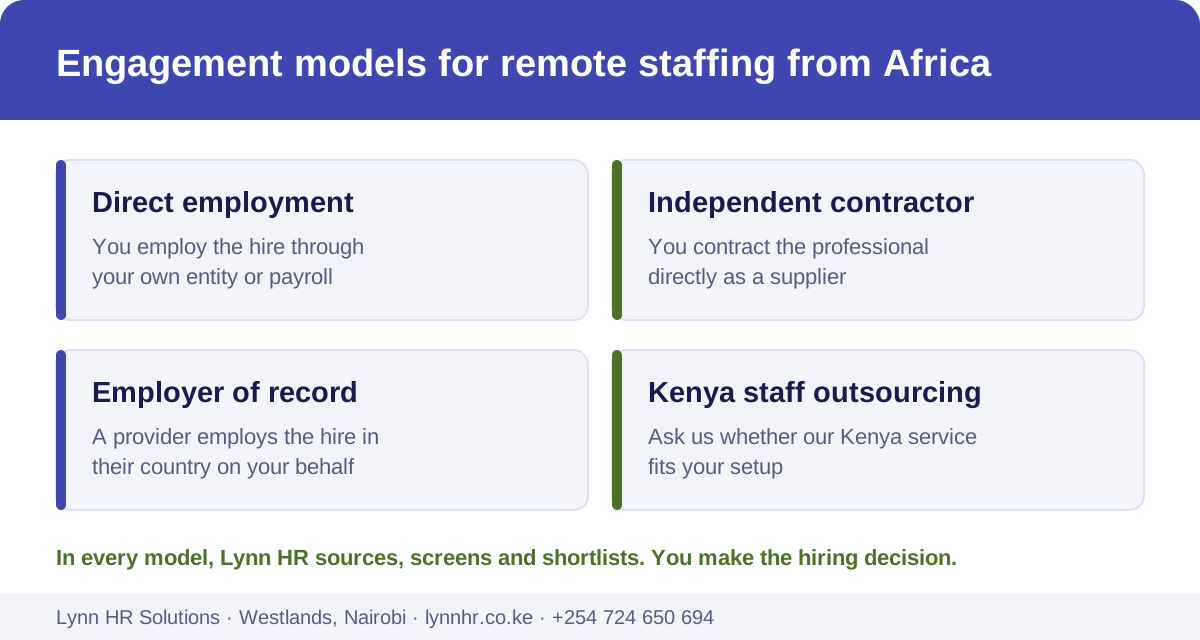
- Direct employment: you employ the professional through your own entity or payroll in their country. Best for larger or long-term teams.
- Independent contractor agreement: you contract the professional directly and pay them as a supplier. Common for one or two hires, but the arrangement must genuinely be a contract for services.
- Employer of record (EOR): a third-party provider employs the person in their country on your behalf and runs local payroll, tax and statutory contributions, while you direct the day-to-day work. We can recruit for you and work alongside the EOR you choose.
- Kenya staff outsourcing: for Kenya-based hires, ask us whether our staff outsourcing service and payroll outsourcing fit your setup. This depends on a case-by-case legal, tax and regulatory review.
Whichever model you choose for remote staffing from Africa, our role stays the same: we source, assess and shortlist, and you make the hiring decision.
How does remote staffing from Africa work with Lynn HR?
Our process follows the fair recruitment principles promoted by the International Labour Organization, and we confirm the steps in writing before we start.
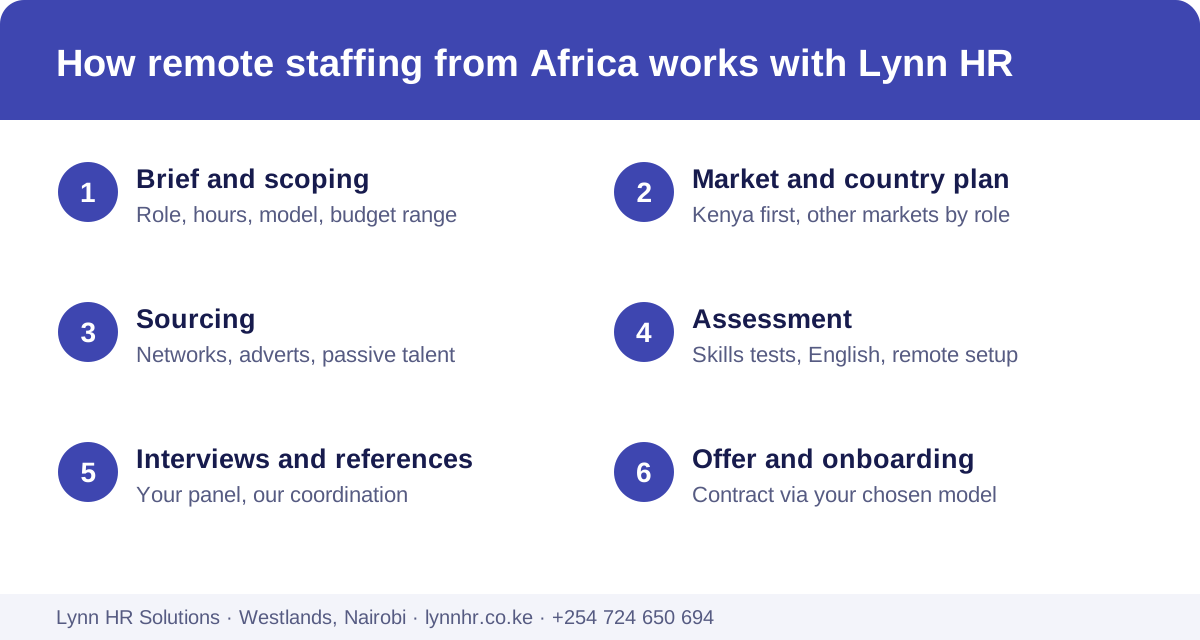
Brief and scoping
We agree the role, outcomes, working hours, time zone, tools, engagement model and pay range, and the profile that would succeed.
Market and country plan
We advise which African markets fit the role and hours, starting with Kenya unless another market is a better match.
Sourcing
We combine targeted adverts, our professional networks and direct approaches to people not actively looking.
Assessment
Structured interviews, role-specific skills tests, English assessment and a remote-readiness check: internet, backup power, workspace and tools.
Interviews and references
We present a shortlist with notes, coordinate interviews across time zones and run reference and experience checks.
Offer and onboarding
We support the offer and hand over to your chosen model: your own contract, an EOR, or our Kenya services where they fit.
For Kenya-based hires, our employment contract service can help prepare compliant contracts, and our HR compliance team can advise on Kenyan employment law.
What compliance rules apply to remote staffing from Africa?
Remote staffing from Africa touches two sets of rules: those in your country and those where the professional lives. This section is general guidance, not legal advice; take advice for your own setup.
Data protection
Kenya's Data Protection Act, 2019 is enforced by the Office of the Data Protection Commissioner (ODPC). Nigeria has the Nigeria Data Protection Commission, and South Africa's POPIA is overseen by the Information Regulator. If you are in the EU, the GDPR applies to personal data you share with remote staff, and the European Commission's standard contractual clauses are the usual transfer tool. UK employers can use the International Data Transfer Agreement described by the ICO. Australian employers should consider the Privacy Act.
Worker classification
If you use contractors, the label in the contract is not enough. The IRS, CRA and ATO all look at control, integration, tools and financial risk, and in the UK the IR35 rules can apply where an intermediary is involved. If the relationship looks like employment, an employer of record or direct employment is often safer.
Local tax and employment law
Employees in Kenya are paid through PAYE and statutory deductions administered by the Kenya Revenue Authority, and are covered by the Employment Act. Other African countries have their own rules, which an EOR or local adviser will handle.
Security
Give remote staff company-managed accounts, multi-factor authentication and role-based access, and document who can see what. We check candidates' comfort with secure working practices during assessment.
What affects the cost of remote staffing from Africa?
We do not publish prices, because every brief is different. These are the factors that shape the total cost of remote staffing from Africa:
- Role, seniority and how scarce the skills are
- The country and its local pay norms
- Working hours, including evening or weekend shifts
- Engagement model: direct, contractor or EOR fees
- Statutory contributions and benefits in that country
- Equipment, internet and backup power allowances
- How many hires you need and how fast
- The scope of recruitment support you choose
We agree the scope, fees and payment terms in writing and send a tailored proposal before any work begins.
How does Africa compare with other offshore regions?
Every offshore region has strengths. The table gives a qualitative view to help you shortlist; the right answer depends on your hours, language needs and roles.
| Factor | Africa (e.g. Kenya) | South Asia | Southeast Asia | Latin America | Eastern Europe |
|---|---|---|---|---|---|
| Overlap with UK and Europe | Strong, near-full day | Partial | Limited | Limited | Strong |
| Overlap with US and Canada | Partial, via later shifts | Limited, mostly night shifts | Limited, mostly night shifts | Strong | Partial |
| Overlap with the Middle East | Strong | Strong | Partial | Limited | Strong |
| English use | Widely used in many markets | Widely used in business | Strong in some markets | Varies by country | Varies by country |
| Market maturity | Growing quickly | Very mature | Very mature in support | Mature for US clients | Mature in tech |
| Typical cost level | Competitive | Competitive | Competitive | Moderate | Higher |
| Best known for | Support, finance, marketing, tech | Tech and back office | Customer support | Tech and sales for the US | Engineering |
In short, remote staffing from Africa stands out for European and Middle East employers who want same-day collaboration, and for North American teams that want early-day coverage or a second hiring market alongside Latin America or Asia.
How to choose a remote staffing partner in Africa
Ask these questions before you sign with any provider of remote staffing from Africa:
- Which countries do you recruit in yourselves, and where do you use partners?
- Do you recruit, employ, or both? Who is the legal employer?
- How do you assess skills, English and remote readiness?
- How do you handle candidate and client data?
- What exactly is included in your fee, and what is not?
- Who is my contact, and in which time zone?
- Can you support more than one engagement model?
- Can I speak to the shortlisted people before deciding?
Be wary of providers that promise unrealistic speed, publish one price for every role, or are vague about who employs the person. Our guide on how to choose the right recruitment agency covers more questions, and our overview of recruitment companies in Kenya helps you compare options.
Common mistakes to avoid
- Hiring before choosing an engagement model
- Calling an employee a contractor to save effort
- Ignoring public holidays and shift patterns
- Skipping a written data protection agreement
- Under-investing in onboarding and tools
- Judging only on CV, without a skills task
A short, structured onboarding plan, clear goals for the first weeks and a named manager make the biggest difference to how quickly remote staff settle in.
FAQs about remote staffing from Africa
What is remote staffing from Africa?
Remote staffing from Africa means hiring professionals who live and work in African countries, such as Kenya, Nigeria, South Africa or Ghana, to join your team remotely. They work your agreed hours from their home country, while you employ or contract them directly or through an employer of record.
Is remote staffing from Africa a good fit for UK and European companies?
Yes, it is one of the strongest fits. Kenya is only one to three hours ahead of the UK and most of Europe, and much of Africa shares a similar working day, so your remote staff work the same hours as your office.
Can US and Canadian companies use remote staffing from Africa?
Yes. Many roles, such as customer support, sales development and virtual assistance, run on an afternoon-to-evening Kenyan shift that covers the US and Canadian morning. Roles that need full overlap with the US West Coast take more planning, and we discuss shift patterns during the brief.
Which countries does Lynn HR recruit from?
Lynn HR is based in Nairobi and Kenya is our core market. For remote roles we can also source professionals in other African countries, such as Nigeria, South Africa, Ghana, Uganda, Rwanda and Egypt, depending on the role and our network there. We do not have offices outside Kenya.
Which roles suit remote staffing from Africa?
Roles that are done on a computer and judged by output work best: customer support, virtual assistants, software developers, digital marketing, finance and accounting, administration and data roles.
Does Lynn HR employ the remote staff for us?
Our core service is recruitment: we source, screen and shortlist, and you hire. You can employ or contract the person directly or use an employer of record. For Kenya-based hires, ask us whether our staff outsourcing and payroll services fit your setup; this needs a case-by-case legal and tax review.
Is it legal to hire remote contractors in Africa?
Generally yes, but the label must match the reality. Tax authorities such as the IRS, CRA, ATO and HMRC look at control and integration, not the contract title, and the worker's own country has rules too. Take legal and tax advice before you choose a model.
How do we protect customer data when staff work from Africa?
Use a written data processing or employment agreement, role-based access and secure devices. EU and UK employers normally need a transfer safeguard, such as the EU standard contractual clauses or the UK International Data Transfer Agreement. Kenya also has its own Data Protection Act, 2019.
How much does remote staffing from Africa cost?
Cost depends on the role, seniority, country, working hours, engagement model and the scope of recruitment support. We agree the scope and fees in writing and send a tailored proposal before any work starts.
Does Lynn HR recruit people to relocate to the Middle East or abroad?
No. This service is for remote roles only: the professional stays in their home country and works online for your company. We do not recruit for overseas relocation or migrant work.
Start remote staffing from Africa with Lynn HR
Tell us the role, your time zone, the engagement model you prefer and when you would like the person to start. We will reply with a sourcing plan and a tailored proposal for remote staffing from Africa.
Lynn HR Solutions, The Mirage, Tower 2, Penthouse Floor, Waiyaki Way, Westlands, Nairobi, Kenya. Phone and WhatsApp: +254 724 650 694. Email: lynn@lynnhr.co.ke. Learn more about our recruitment services in Kenya or visit the Lynn HR home page.
Build your remote team in Africa
Whether you need one remote professional or a whole team, tell us about the role, your hours and your timeline.