
Home / Recruitment / Casual Workers / Bulk Recruitment
Bulk Recruitment in Kenya
When a project needs 20–500 casual workers, we plan the sourcing, screening, onboarding and attendance so your team can focus on the work.
Bulk recruitment in Kenya is a different job from hiring a handful of workers. When a harvest, a census-style data exercise, a warehouse launch, a construction phase or a national campaign needs 20–500 casual workers, the risk is not just finding people. It is getting the right people to the right sites on the same morning, with records that stand up later.
Lynn HR plans and runs large casual worker intakes for employers. We agree the roles and numbers with you, source and screen in batches, onboard workers with the documents you need, and supply them in waves to match your project plan.
Bulk intakes can cover any of the roles in our casual workers service. You can engage the workers directly, or Lynn HR can employ them through staff outsourcing and run their payroll and statutory deductions.
Planning bulk recruitment in Kenya for a project? Contact Lynn HR with your requirements to discuss availability and request a quotation.
When Bulk Recruitment in Kenya Makes Sense
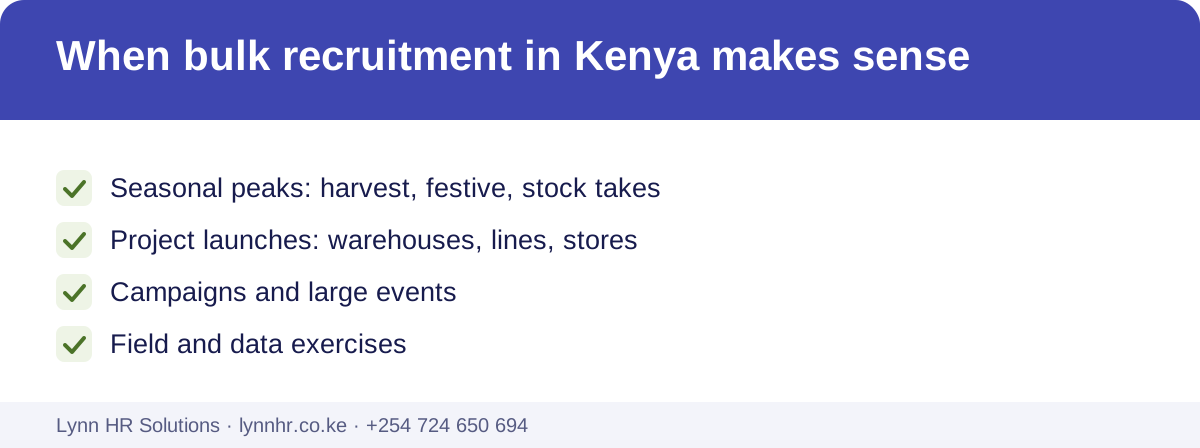
We usually see bulk requests in these situations:
Seasonal peaks
Harvest and packhouse seasons, festive retail, back-to-school distribution and year-end stock takes all need large teams for a set period.
Project launches
New warehouses, factory lines, store openings and large construction phases often need a full team on day one, followed by smaller top-ups.
Campaigns and events
Nationwide product activations, sampling drives and large events can need hundreds of promoters, ushers and setup crew across several towns.
Data and field exercises
Surveys, registrations and distribution drives need many field workers with basic smartphone skills for a short, intense period, plus supervisors who can check quality, resolve problems on the spot and report progress every day.
Typical roles in a bulk intake include warehouse workers, construction workers, packers, promoters and general labourers.
How We Run a Bulk Intake
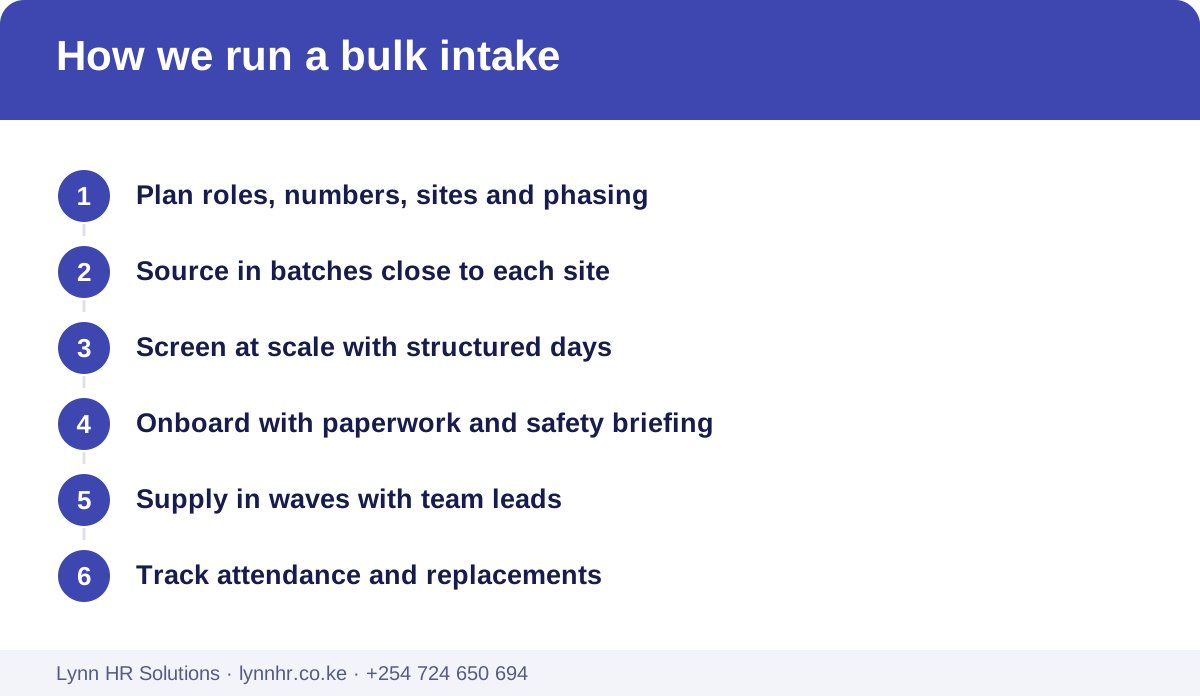
Large intakes succeed on planning. This is the process we follow for bulk recruitment in Kenya:
Plan the workforce
We agree roles, numbers per site, start dates, shift patterns and the phasing of the intake, along with the selection criteria for each role.
Source in batches
We advertise and source by role and location, prioritising candidates who live close to each site to cut lateness and transport costs.
Screen at scale
We run structured screening days: ID and age checks, short interviews, practical tests where relevant and reference checks for supervisors.
Onboard properly
Each worker completes the agreed paperwork, including personal and payment details, statutory numbers and a briefing on site rules and safety.
Supply in waves
Workers are supplied to each site with named lists and team leads, and we hold a pool of screened back-ups where possible.
Manage attendance
We track daily attendance by site, manage replacements as agreed and give you regular updates on numbers.
Need workers for an upcoming project? Contact Lynn HR with your requirements to discuss availability, timelines, and recruitment fees.
Key facts: bulk recruitment in Kenya
- Range: We plan intakes of 20–500 casual workers for a single project.
- Conversion: Continuous casual work equal to a month or more is treated as monthly-paid employment under section 37 of the Employment Act.
- Written contracts: A contract for three months or more must be in writing.
- Sexual harassment policy: An employer with 20 or more employees must issue a policy statement on sexual harassment.
- Safety committees: Under OSHA, a workplace with 20 or more employees must set up a safety and health committee.
- Housing Levy: KRA requires 1.5% of the employee's gross pay plus a matching 1.5% from the employer.
Compliance for Bulk Recruitment in Kenya
Scale magnifies small mistakes. A missed deduction or an unclear contract repeated across 300 workers becomes a serious liability, so we build compliance into the plan from day one.
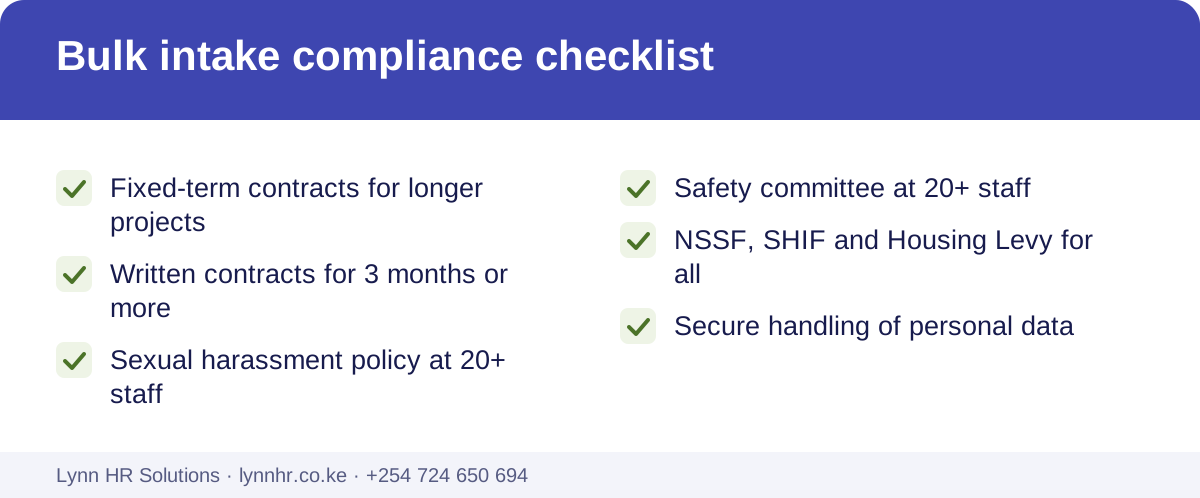
Under the Employment Act, a casual employee is paid at the end of each day, and continuous casual work equal to a month or more is treated as monthly-paid employment under section 37. Most bulk projects run longer than that, so fixed-term contracts are usually the right tool. Any contract for three months or more must be in writing. An employer with 20 or more employees must also issue a sexual harassment policy statement, and under OSHA a workplace with 20 or more employees must set up a safety and health committee.
Every worker should be registered for statutory deductions. That means contributions to the National Social Security Fund, SHIF and the Affordable Housing Levy, which KRA has confirmed must be deducted from employees' gross pay and matched by the employer. Our payroll outsourcing team can run pay for large casual teams. Large intakes also mean handling personal data at scale, so we keep candidate records secure and use them only for the agreed purpose, in line with the Data Protection Act, 2019.
Sectors and Locations for Bulk Intakes
Bulk intakes come from agriculture and packhouses, logistics and e-commerce, manufacturing, construction and infrastructure, retail and FMCG, events and promotions, and NGOs and research firms running field exercises.
Field exercises and campaigns often need workers who speak local languages or know the area well, and we build that into the selection criteria for each site. We are based in Westlands, Nairobi. For multi-county intakes, we plan sourcing close to each site where candidate availability allows, and tell you early if a location needs more lead time.
What to Share for a Bulk Quote
To plan bulk recruitment properly, we need:
- Roles and numbers per site
- Start date and phasing
- Project length and shift patterns
- Selection criteria and any tests
- Who employs and pays the workers
- PPE, uniforms and transport arrangements
Plan the end of the project too. Agree how and when workers will be released, how final pay and deductions will be settled, and who issues documents. Under the Employment Act, an employer must issue a certificate of service when employment ends, unless it lasted less than four consecutive weeks. For large teams, we also set up simple communication by site, such as SMS or group messages through team leads, so changes to shifts reach everyone the same day.
The earlier you share these, the more time we have to source locally and screen properly.
FAQs About Bulk Recruitment in Kenya
How many workers can you supply in one intake?
We plan intakes of 20–500 casual workers for a project. The timeline depends on the roles, locations and screening required.
How early should I start bulk recruitment in Kenya?
As early as you can. Share your plan as soon as the start date is known, so we can source locally and screen properly.
Can you supply workers to several counties at once?
We can discuss multi-site intakes and will confirm which locations need more lead time.
Should bulk workers be casual or on contracts?
It depends on the project length. Most bulk projects run past a month, so fixed-term contracts or staff outsourcing are usually the better fit.
Can Lynn HR pay the workers?
Yes, through staff outsourcing. We employ the workers, run payroll and statutory deductions, and invoice you.
What happens if workers drop out?
We agree a replacement process in the plan and keep a pool of screened back-ups where possible.
Planning Bulk Recruitment in Kenya?
Tell us the roles, numbers per site, start date and project length. We will come back with an intake plan and a quotation.
Planning Bulk Recruitment in Kenya?
Lynn HR: recruitment and HR support for growing businesses in Kenya.