
Home / Recruitment / Casual Workers / Factory Workers
Hire Factory Workers in Kenya
Production assistants, machine operators and packers for manufacturers and processors in Nairobi, Athi River, Thika and across Kenya.
Do you need factory workers in Kenya for a seasonal production peak, a new product line or a planned shutdown? Lynn HR supplies production assistants, machine operators and packers to food and beverage plants, plastics and packaging firms, pharmaceutical and cosmetics makers, and other manufacturers.
Factories run on output targets, hygiene standards and safety rules, and a new worker who is not ready for all three slows the line. We screen for the right experience, brief workers on what your floor expects, and supply them on the shifts you set.
This is one of the roles in our casual workers service. You can engage the workers directly, or have Lynn HR employ them through staff outsourcing and run their wages and statutory deductions.
Need factory workers in Kenya for a production peak? Contact Lynn HR with your requirements to discuss availability and request a quotation.
Factory Workers in Kenya We Supply
We match people to the process, the product and the hygiene level of your plant.
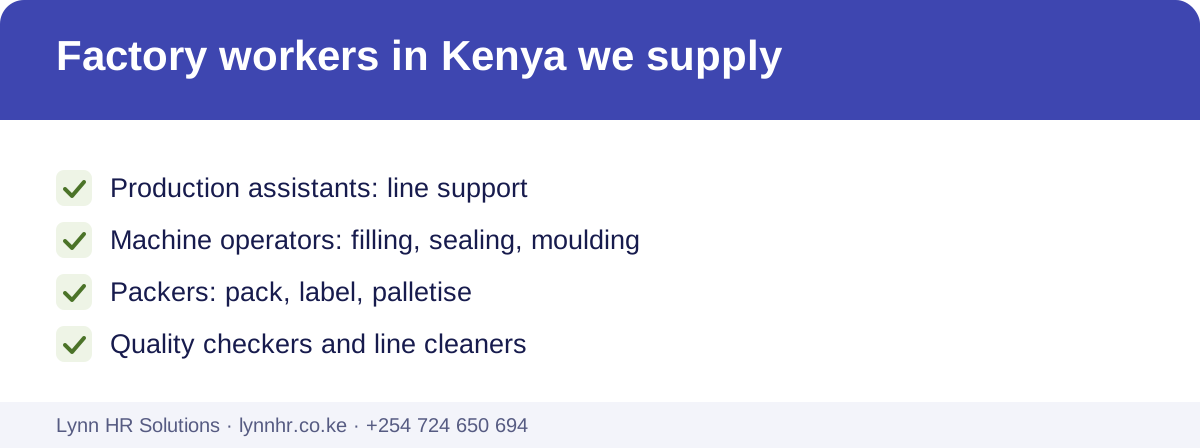
Production assistants
Production assistants feed materials to the line, move work in progress, weigh and mix ingredients to instruction, clean down between batches and keep the floor clear. In food, beverage and pharmaceutical plants we look for people who understand hygiene rules such as hairnets, handwashing and no jewellery.
Machine operators
Operators run filling, sealing, moulding, cutting, printing or labelling machines, carry out basic checks and changeovers, and stop the line when something is wrong. Because OSHA requires machinery to be operated only by a competent person, we look for proven experience on similar equipment and expect you to confirm competence on your own machines before they work alone.
Packers
Packers count, pack, seal, label and palletise finished goods, check codes and expiry dates, and set aside rejects. Accuracy and pace both matter, so we screen for attention to detail and steady work over long shifts. A wrong code or a short-packed carton can trigger a recall or a customer claim, so packers are briefed on your checks.
- Quality checkers and sorters
- Line cleaners and hygiene crews
- Store and dispatch helpers
- Shutdown and maintenance labourers
How We Vet and Supply Factory Staff
We vet factory workers in Kenya for safety awareness and discipline on the line, as well as for skill.
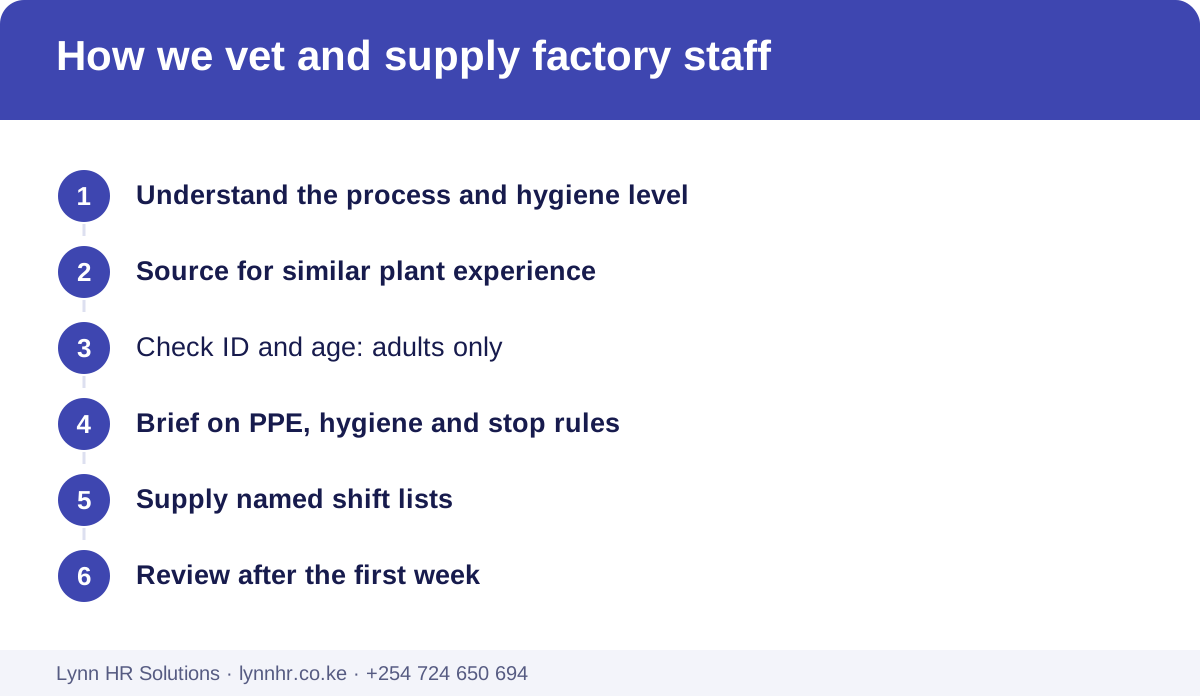
Understand the process
We confirm the roles, machines, shift pattern, hygiene level, PPE and any medical or food handler requirements.
Source for experience
We look for people who have worked in similar plants, and take references from supervisors where available.
Check ID and age
We supply adults only. The Employment Act restricts work by children in industrial undertakings and around machinery.
Brief on rules
Workers are briefed on PPE, hygiene, lock-out and stop-the-line rules before their first shift, ahead of your own induction.
Supply by shift
You receive named shift lists, and we coordinate gate passes, PPE issue and reporting with your production supervisor.
Review and adjust
We follow up after the first week, act on supervisor feedback and agree how absences are covered.
Need workers for an upcoming project? Contact Lynn HR with your requirements to discuss availability, timelines, and recruitment fees.
Key facts: hiring factory workers in Kenya
- Competent operators: OSHA allows plant and machinery to be operated only by a competent person.
- Guarding: Dangerous parts of machinery must be securely fenced or guarded under OSHA.
- Children: The Employment Act bars children aged 13 to 16 from attending to machinery in industrial undertakings and limits night work by children.
- No charge for safety: Ear defenders, goggles, gloves and other gear provided under OSHA cannot be deducted from pay.
- Safety committees: A workplace with 20 or more employees must set up a safety and health committee.
- Production runs: Line workers kept on continuously for a month or more are treated as monthly-paid under section 37 of the Employment Act.
Safety Law for Factory Workers in Kenya
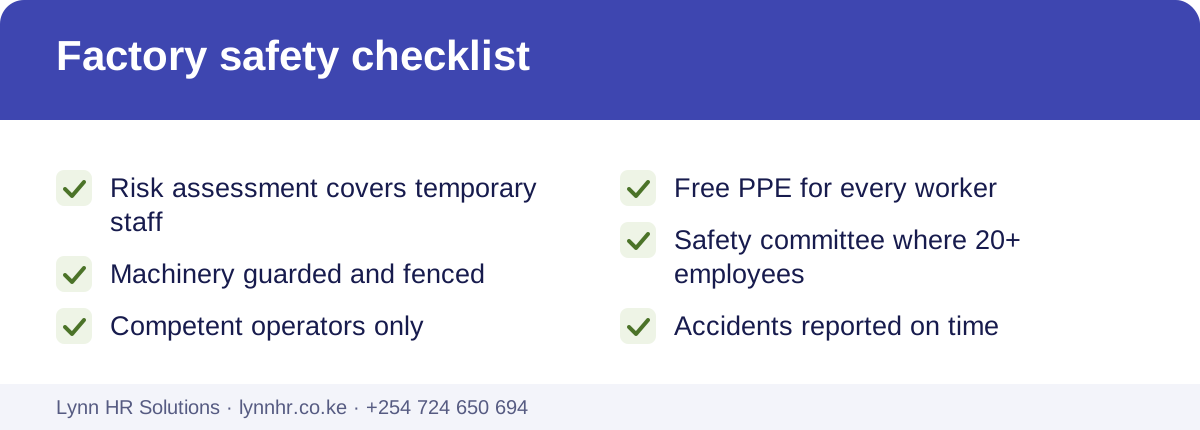
Factories are among the most closely regulated workplaces under the Occupational Safety and Health Act, 2007. The occupier must carry out risk assessments, keep plant and systems of work safe, and give every worker the information, instruction, training and supervision they need. Dangerous parts of machinery must be securely fenced or guarded, and plant may only be used for its designed purpose and operated by a competent person.
Temporary staff are covered from their first hour, so include them in your induction, toolbox talks and accident reporting. Workers cannot be charged for protective equipment provided under the Act, and a workplace with 20 or more employees must set up a safety and health committee. Fatal accidents must be reported to the area occupational safety and health officer within 24 hours.
Industry bodies such as the Kenya Association of Manufacturers represent manufacturers on policy and standards and are a useful source of sector updates. On the employment side, long production runs can turn casual work into monthly-paid employment under section 37 of the Employment Act, so plan contracts to match how long you will need the workers. Our employment contract and payroll outsourcing teams can help.
Industries and Locations
We supply teams to food and beverage processors, bakeries, dairies, flour mills, plastics and packaging plants, printing firms, pharmaceutical and cosmetics manufacturers, paint and chemical plants, steel and metal fabricators, and textile and garment factories, including export processing zones.
Manufacturing in our area is concentrated in Nairobi's Industrial Area, Baba Dogo, Ruaraka, Mombasa Road, Athi River, Ruiru, Thika and Tatu City. Tell us where your plant is, and we will confirm whether we can source locally.
Planning Factory Staffing
The more we know about your line, the better we can match people to it. Before requesting workers, consider:
- Roles and machines involved
- Shift pattern, including nights and weekends
- Hygiene level and medical checks required
- PPE and who issues it
- Expected length of the production peak
- Supervisor ratio on each shift
Many plants start new workers on a short, paid trial shift with an experienced operator before adding them to the roster. It shows quickly who can keep pace with the line and follow hygiene rules, and it gives your supervisors a say in who stays. If your plant sits in an export processing zone or a bonded area, share the gate and security procedures early so passes are ready on day one.
For finished goods leaving the plant, our warehouse workers page covers loaders, packers and sorters.
FAQs About Hiring Factory Workers in Kenya
Can you supply experienced machine operators?
Yes, where candidates with experience on similar machines are available. You should still confirm competence on your own equipment before an operator works alone.
Do factory workers in Kenya need medical checks?
Some roles do, such as food handling and certain hazardous processes. Tell us your requirements and we will build them into screening.
Can you supply night shift workers?
Yes, where your plant runs nights. We confirm shift times upfront and recommend safe transport.
Who provides PPE?
Usually the factory, as the occupier. It cannot be charged to the workers under OSHA.
Can workers stay casual through a long production run?
Not usually. Continuous casual work can convert to monthly terms, so for longer runs we suggest fixed-term contracts or staff outsourcing.
Can you supply a shutdown crew?
Yes. Share the shutdown dates, tasks and safety rules, and we will plan a team of labourers and helpers.
Need Factory Workers in Kenya?
Tell us the roles, shifts, numbers and plant location. We will come back with a staffing plan and a quotation.
Need Factory Workers in Kenya?
Lynn HR: recruitment and HR support for growing businesses in Kenya.