
Home / Recruitment / Casual Workers / Warehouse Workers
Hire Warehouse Workers in Kenya
Loaders, off-loaders, packers and sorters for distribution centres, stores and logistics yards in Nairobi and across Kenya.
Looking for warehouse workers in Kenya to cover a peak season, a stock take or a new distribution contract? Lynn HR supplies loaders, off-loaders, packers and sorters to warehouses, distributors, manufacturers, e-commerce fulfilment centres and logistics yards.
Warehouse demand rarely moves in straight lines. A container lands early, a retailer doubles an order before the holidays, or an audit needs every pallet counted over a weekend. We help you add the right people for that window and release them when volumes settle.
We can recruit workers for you to engage directly, or employ and pay them through staff outsourcing while your shift leaders run the floor. Either way, you get one contact person who knows your site, your shift times and the standards your own team works to.
Need warehouse workers in Kenya for a busy period? Contact Lynn HR with your requirements to discuss availability and request a quotation.
Warehouse Workers in Kenya We Supply
We match each role to your operation: the products you handle, how they are stored and how fast they need to move.
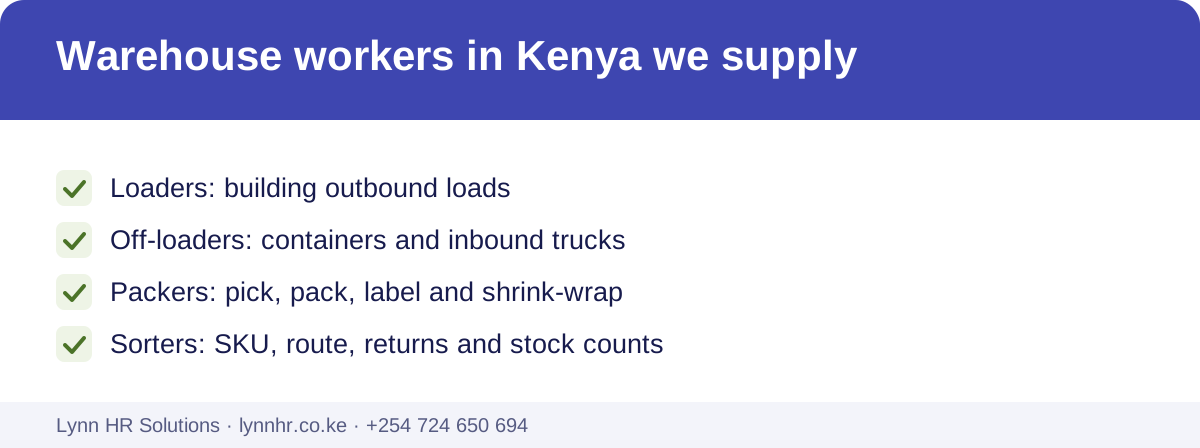
Loaders
Loaders build outbound orders onto trucks, vans and motorbikes, following load plans so heavy goods go at the bottom and drops come off in route order. We look for care with fragile stock, as well as strength.
Off-loaders
Off-loaders receive containers and inbound trucks, de-stuff cartons and sacks, count against delivery notes and stage goods for put-away. For loose-loaded containers we brief workers on team lifting and safe stacking heights.
Packers
Packers pick, pack and label orders, rework promotional packs, shrink-wrap pallets and assemble gift hampers. Accuracy matters as much as speed, so we screen for attention to detail and basic numeracy.
Sorters
Sorters separate goods by SKU, route, batch or grade, process customer returns and damaged stock, and help with cycle counts and full stock takes. Some sorting roles need handheld scanner experience, and we ask about it upfront.
How We Supply and Manage Warehouse Staff
Good warehouse workers in Kenya learn your floor quickly and turn up every shift. Our process is built around that.
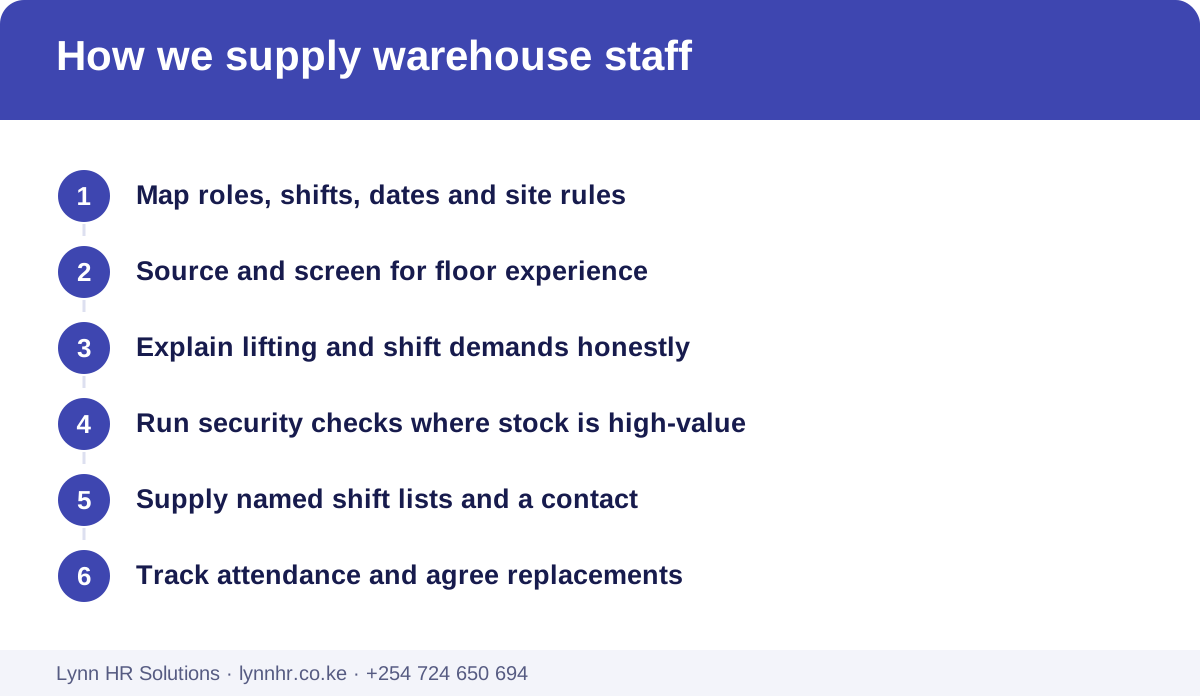
Map the shifts
We confirm roles, numbers per shift, start and end dates, the site address and any client audit or security rules.
Source and screen
We look for people with warehouse, distribution or factory floor experience, check national ID and age, and take references where available.
Assess fitness for the task
We explain the lifting, standing and shift demands honestly, so workers who accept the role know what the job involves.
Security checks where needed
For high-value stock, we take extra care checking ID and references before workers start.
Supply with a shift list
You receive named shift lists and a contact person, and we coordinate reporting times, gate passes and PPE collection.
Track attendance
Under staff outsourcing we keep daily attendance and pay records, and agree how replacements are handled when someone does not report.
Need workers for an upcoming project? Contact Lynn HR with your requirements to discuss availability, timelines, and recruitment fees.
Key facts: hiring warehouse workers in Kenya
- Daily pay: Under the Employment Act, a casual employee's wages are due at the end of each day.
- Long peaks: A warehouse temp who works continuously for the equivalent of a month moves onto monthly terms under section 37.
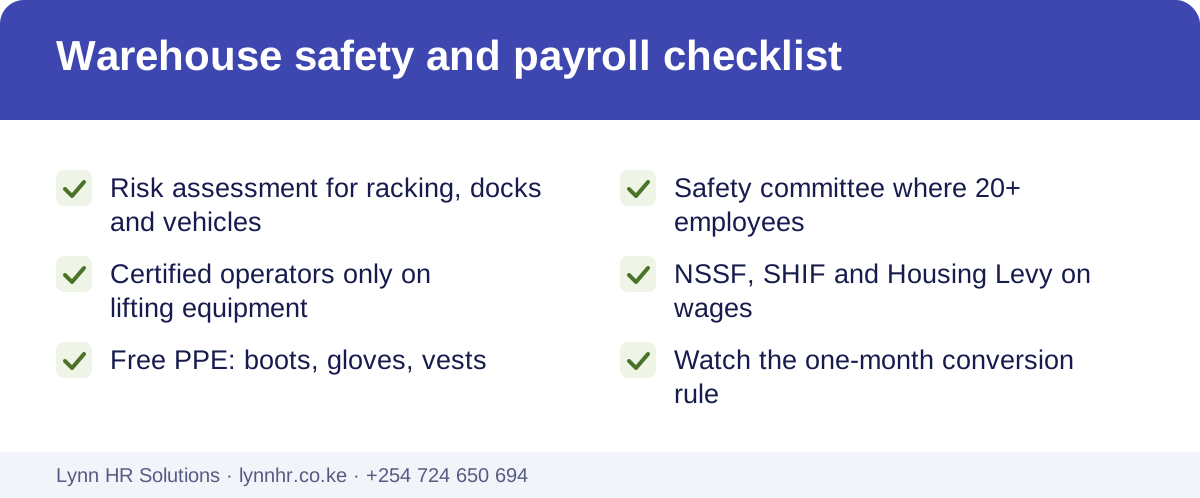
- Lifting machines: OSHA requires operators of lifting machines to be trained and certificated, and bars anyone under 18 from operating them.
- Free PPE: Boots, gloves and vests issued under OSHA are an employer cost and cannot be recovered from wages.
- Safety committees: A workplace with 20 or more employees must set up a safety and health committee under OSHA.
- Housing Levy: KRA treats wages paid to casual warehouse staff as subject to the levy: 1.5% deducted, plus 1.5% from you.
Safety and Statutory Rules for Warehouse Workers in Kenya
Warehouses are workplaces under the Occupational Safety and Health Act, 2007. The occupier must provide safe systems of work, carry out risk assessments and give each worker the instruction and supervision needed to work safely. Racking, narrow aisles, loading docks, manual lifting and moving vehicles are the usual hazards, so walkways and loading bays should be clearly marked.
Plant and machinery may only be operated by a competent person, and OSHA adds specific rules for lifting machines such as cranes, winches and hoists: operators must be trained and certificated, and nobody under 18 may operate them. In practice, treat forklifts the same way. We do not put general warehouse temps on forklifts unless they hold a valid operator certificate and you have authorised it.
Pay rules apply from the first shift. A casual worker is paid at the end of each day. Workers kept for continuous periods move onto monthly terms under section 37 of the Employment Act, which is common in long peak seasons. Employers also need to handle statutory contributions to the National Social Security Fund, SHIF and the Affordable Housing Levy, which KRA says applies to casual wages too. Our payroll outsourcing team can run these for you.
Who We Supply Warehouse Teams To
We work with FMCG distributors, manufacturers with finished-goods stores, importers clearing containers, e-commerce and last-mile delivery hubs, agricultural produce packhouses, pharmaceutical and medical supply stores, and retail chains with central warehouses.
Most warehouse clusters we cover are in Nairobi's Industrial Area, Baba Dogo, Mombasa Road, Syokimau, Athi River, Ruiru and Tatu City. If your store is in another county, tell us early so we can plan local sourcing.
Planning for Peak Season and Stock Takes
The best results come from booking early and being specific. Before you request warehouse staff, think through:
- Expected volumes per day or per shift
- Whether night shifts or weekends are needed
- Which roles need scanner or WMS skills
- PPE: safety boots, gloves and reflective vests
- Transport for late shifts
- How long the peak is likely to last
For a stock take, we suggest a short briefing before counting starts and pairing new counters with your own staff, so every team of warehouse workers in Kenya we supply counts the same way. For related roles, see our pages on general labourers and factory workers.
FAQs About Hiring Warehouse Workers in Kenya
How many warehouse workers can I request?
Anything from a handful of off-loaders for a single container to a full peak-season team. For 20 or more workers, see our bulk recruitment page.
Can warehouse workers in Kenya work night shifts?
Yes, where your site runs nights. We confirm shift times upfront and recommend safe transport for late finishes.
Do you supply forklift operators?
Only workers who hold a valid operator certificate, and only where you authorise it. General warehouse temps are not put on forklifts.
Can you supply warehouse staff for a weekend stock take?
Yes. Give us the date, count hours and number of counters, and we will plan a team with a short briefing before counting starts.
Who pays the workers?
If you engage the team yourself, you run their pay. Under staff outsourcing, we pay the workers, remit their deductions and send you one invoice.
How do you handle no-shows?
We agree a replacement process in the scope, keep a list of screened back-up workers where possible, and keep you updated on reporting.
Need Warehouse Workers in Kenya This Season?
Share the roles, number of workers per shift, location and dates. We will come back with a staffing plan and a quotation.
Need Warehouse Workers in Kenya This Season?
Lynn HR: recruitment and HR support for growing businesses in Kenya.